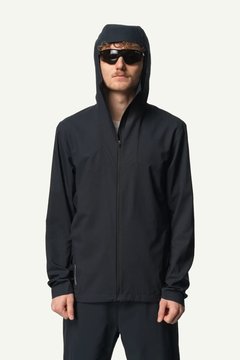
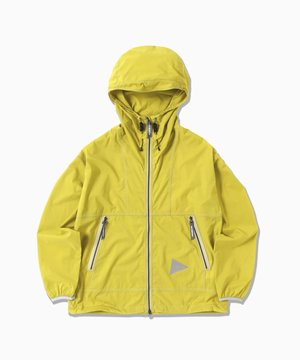
And Wander vs Houdini Wind Shells
Two hooded wind shells. Both light. Both built for moving in wind: Houdini pitches its jacket squarely at running, training and cycling, while the and wander comes from a brand whose outdoor pieces also cross into everyday wear. The and wander PERTEX wind jacket and the Houdini Pace Trail Houdi do the same job by different routes: a branded Pertex nylon on one side, Houdini’s own recycled polyester on the other.
An earlier version of this page set the and wander against Houdini’s The Orange Jacket. That jacket is a waterproof shell rated to 20,000 mm, not a wind shell, so the Pace Trail Houdi takes its place here.
Figures come from the manufacturers’ own stores: and wander’s official shop at mix.tokyo, which andwander.com links to, and houdinisportswear.com. Where a figure is not published there, it is marked as such. Prices and stock are as of October 2026.
and wander PERTEX wind jacket
and wander is a Japanese brand that sits at the intersection of outdoor function and considered design. The PERTEX wind jacket returns each season under the same name with a new style code. The 2026 version, 5746921016, is listed on the official store as a 2026 core item in nine colours.
The shell is Pertex Quantum Air, a 20-denier high-strength nylon. That is not plain Pertex Quantum, which Pertex positions as a downproof fabric for down jackets and sleeping bags. Pertex describes Quantum Air as an open-woven construction and positions it for active mid-layers and lightweight windshells. Pertex engineers it across an air-permeability range of under 2 to 70 cc/cm²/s (ASTM D737). Water resistance comes from a DWR finish that Pertex says keeps an 80-point spray rating after 20 washes. and wander does not say where in that range its version sits, or what chemistry its DWR uses.
The official listing describes the 20-denier yarn as woven at high density and calls the fabric windproof and water-repellent. It makes no breathability claim. The Japanese product title includes the word “waterproof”, but the description gives no waterproof rating. It is a wind shell.
Stockist listings describe a hood with a short brim and drawcord adjustment, a two-way front zip, two zippered side pockets and a drawcord hem; none of them lists a chest pocket. The official listing adds reflective stitching and an included pouch the jacket packs into. The official store gives the weight as 208 g without naming the size. Sizing is unisex S to XXL, plus women’s WS and WM.
The price on the official store is JPY 41,800 including tax. and wander publishes no US-dollar or euro price; outside Japan, the stockist sets the price.
Houdini Pace Trail Houdi
Houdini Sportswear is a Swedish brand with a long record in minimal, function-first outerwear. The Pace Trail Houdi is the hooded wind jacket in its Pace series, built for running, training and cycling.
It uses C9 Ripstop, Houdini’s own fabric: 100% recycled and recyclable polyester at 65 g/m², produced in Japan, with a PFAS-free water-repellent treatment. Houdini rates its air permeability as “excellent” but publishes no number, so a figure-to-figure comparison with Quantum Air is not possible.
The feature list is short: regular fit, a foldable hood with a button attachment, zippered side pockets, elastic sleeve ends and an adjustable hem. Houdini lists no hood drawcord and no stuff pocket, only “highly packable”. Weight is 170 g in men’s large and 150 g in women’s medium. The garment is made in Vietnam.
Availability is the catch. As of October 2026, every Pace Trail Houdi colourway sits in Houdini’s Archive, discounted from a US$210 regular price to US$126-147 on the US store, with several sizes sold out. The same is true of Houdini’s other light wind jackets, including the Pace Trail Jacket and Pace Wind Jacket, and Houdini has not said whether the Pace Trail Houdi continues into 2027. Its current full-price alternative is The Orange Jacket, a 200 g (men’s large), US$320 waterproof shell for buyers who would rather carry one layer that also handles rain.
How They Compare
On paper the Houdini is lighter: 170 g in men’s large against 208 g for the and wander in an unstated size. and wander does not say which size its figure is for, so the gap is approximate.
Houdini sells the Pace Trail Houdi on air flow: it calls C9 Ripstop highly breathable and rates its air permeability as excellent. and wander sells its jacket as windproof, describing a 20-denier nylon woven at high density. Pertex makes Quantum Air across a wide permeability range, and neither brand publishes a figure for its jacket.
On materials, Houdini is more transparent. The Pace Trail Houdi is recycled, recyclable polyester with a PFAS-free finish, and Houdini runs a take-back scheme for worn-out garments. and wander states 100% nylon and nothing about recycled content or DWR chemistry. Houdini Sportswear also appears on bluesign’s system-partner brand list (September 2026). That is a brand-level partnership, not a certification of this jacket. An earlier version of this page described a Fair Trade certification; we found no evidence of one, and the claim has been removed.
On features, the and wander leads: a brimmed, adjustable hood, a two-way zip and an included pouch. On price, the Houdini is cheaper while Archive stock lasts.
Aesthetic diverges. and wander reads Japanese outdoor-minimalist, with seasonal colourways that cross over into streetwear. The Pace series is plainer and more running-coded.
Closing
Both are hooded wind shells under 210 g from brands with coherent points of view. The and wander is the current product, with the better hood and a fabric built for the job. The Houdini is lighter on paper, recycled and cheaper, but it is Archive stock with no confirmed 2027 run. If a buyer’s size is still in Houdini’s Archive, it is a sound pick. If not, the and wander is the current choice.