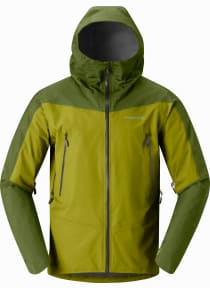
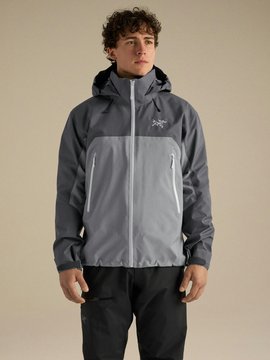
Arc’teryx Beta AR vs Norrøna Falketind Gore-Tex
Two three-layer Gore-Tex shells, one direct comparison. The Arc’teryx Beta AR and the Norrøna Falketind Gore-Tex Jacket occupy similar territory: all-conditions rain protection with helmet-compatible hoods, zippered underarm vents and an eye toward alpine use. The Gore-Tex tier separates them, and that distinction cascades into weight, durability and price. Specs and prices come from the manufacturers’ own stores, as of October 2026.
Arc’teryx Beta AR Jacket
The Beta AR is built on GORE-TEX PRO ePE, the top tier in the Gore-Tex lineup. The revision went on sale on 31 July 2025 under the same name, and the US price rose from $600 to $650 (Gear Patrol, 2025). Arc’teryx positions it as a shell for all-round mountain use (arcteryx.com) and describes both the membrane and the DWR as free from intentionally added PFAS.
The construction is dual-fabric. A 100d face covers the yoke and upper arms, the zones that take pack straps and rock, and an 80d face covers the body to save weight. Arc’teryx lists the jacket at 460 g. Gear Patrol puts the previous version at 461 g, so the weight is effectively unchanged.
The hood is a helmet-compatible DropHood with a precision adjustment system and internal cordlocks; Arc’teryx says it adjusts without cutting into peripheral vision. A RECCO reflector sits in the brim. Pit zips are the active ventilation. Arc’teryx uses articulated patterning for unrestricted movement, glove-friendly Velcro cuff tabs and an adjustable hem drawcord.
Pocket layout is minimal: two zippered hand pockets and an internal chest pocket. Gear Patrol calls the pockets pack-friendly. Fit is Regular, which Arc’teryx describes as cut to layer over or under its other pieces.
Arc’teryx’s spec sheet lists no waterproof or breathability figures; its Guest Services team, answering on the product page, gives 28,000 mm of waterproofness and declines to quote a RET. At US$650, €650 or £600 it sits near the top of the rain-shell category. The Beta AR is a working shell, not a gram-count exercise: it trades weight for durability and feature depth.
Norrøna Falketind Gore-Tex Jacket
The Falketind Gore-Tex Jacket is a three-layer shell in standard GORE-TEX on the ePE membrane: a 30D recycled-nylon face and backer, 101 g/m². The current version has been on sale since September 2024. Norrøna calls it its most versatile waterproof jacket, made for all-year mountaineering but suited to anything from trekking to ski touring (norrona.com).
Norrøna publishes 28,000 mm of waterproofness, the same figure Arc’teryx gives for the Beta AR, and a RET under 13, which Arc’teryx does not publish. The listed weight is 356 g, about 104 g under the Beta AR.
Like the Beta AR, it has zippered underarm vents: Norrøna fits long ones with two-way zippers. The hood is a storm hood sized for a helmet, with one-hand adjustment, and the asymmetric cuffs close with Velcro. Pockets are mid-mounted: WearTesters (2024) describes zippered hand pockets placed to work with a backpack or waistpack, plus a hidden inner pocket.
Fit is what Norrøna calls technical, with a Y-cut and articulated arms. WearTesters describes it as slim through the body, with room for insulating layers and generous length in the body and sleeves.
An earlier version of this page described the Falketind as a 2.5-layer Paclite Plus shell without pit zips. That construction belonged to a separate model, the Falketind Gore-Tex Paclite Jacket, which has since been discontinued.
On Norrøna’s own store the Falketind is US$599, €549 or £500, below the Beta AR in all three markets.
How They Compare
The Gore-Tex tier gap is the central fact here. Both shells use Gore’s ePE membrane, but the Beta AR’s GORE-TEX PRO ePE with 80d and 100d faces is built for more abuse than the Falketind’s 30D standard GORE-TEX. If a shell is being used for actual alpine climbing, with pack straps, rock and repeated compression, the Beta AR is the better bet for a long service life. For trekking, fast hiking or ski touring where the jacket lives in a pack much of the time, the Falketind’s lighter build is adequate and saves 104 g.
Venting does not separate them. Both have zippered underarm vents, so neither forces a choice between overheating and opening the front.
Fit philosophy differs. The Beta AR is a Regular fit; the Falketind a technical Y-cut. Neither is universally better; this depends on intended layering and body type.
On transparency, Norrøna leads narrowly. Both brands publish weights and cite 28,000 mm of waterproofness; only Norrøna gives a breathability (RET) figure. On price, the Falketind is cheaper everywhere, by about $50 in the US and about £100 or €100 in Europe.
Closing
For sustained technical use in variable alpine conditions, the Beta AR’s GORE-TEX PRO ePE construction makes it the more durable tool. For trekking, ski touring and lighter mountain objectives where weight and price matter more than abrasion resistance, the Falketind is a credible, lower-cost alternative with zippered underarm vents of its own. The choice hinges on use case, not brand.