Best One-Person Tents Under 2 lb
Four trekking-pole tents cover the main options for a solo shelter under 2 lb (907 g): the Zpacks Plex Solo Classic, Tarptent Notch Li, Six Moon Designs Lunar Solo and Durston X-Mid 1. They are ranked by each maker’s weight without stakes or poles, lightest to heaviest. Prices are US list prices.
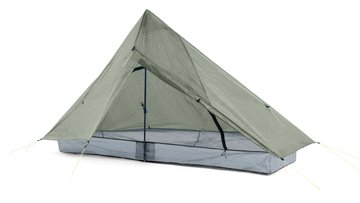
1. Zpacks Plex Solo Classic — 348 g (12.3 oz)
The Zpacks Plex Solo Classic is the Plex Solo under a new name. In June 2026 Zpacks added the Plex Solo Pro ($649, from 373 g), with zippered storm doors and a peak vent. The Classic keeps overlapping, zipperless storm doors and one screen door.
At 348 g with the Lite floor, it is the lightest tent here by more than 200 g. That figure excludes the 8 g stuff sack and the six to ten stakes it needs. Canopy and floor are DCF in two weights each; the heavier options bring it to 378 g or 413 g. It is a single-wall tent with taped seams, pitched on one 52 in pole, and Zpacks sizes it for hikers up to about 6 ft. It costs $599.
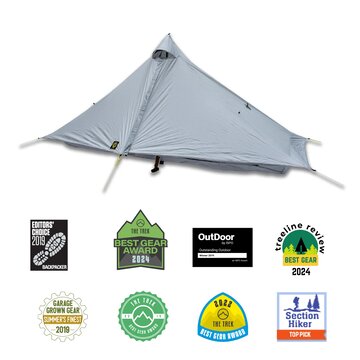
2. Tarptent Notch Li — 573 g (20.2 oz)
The Tarptent Notch Li is a double-wall DCF tent, not the silpoly and silnylon an earlier version of this page described. Tarptent calls it its lightest double-wall design and has made the Notch in DCF since 2018. The July 2026 revision adds larger peak vents and more reinforcement.
The 573 g minimum applies to the mesh inner with a 0.96 DCF floor, at $529. Nylon floors cost $499 with the mesh inner, about 30 g heavier, or $529 with the solid inner. Tarptent says DCF is more prone to punctures and abrasion than nylon.
Four 16 in carbon struts hold out the ends, which Tarptent says adds interior space, stability and ventilation. Two trekking poles and four stakes complete a fly-first pitch, and two doors open onto two 8 sq ft vestibules. The trade-off is width: the 84 in floor is 34 in wide at the middle and tapers to 20 in toward the ends.
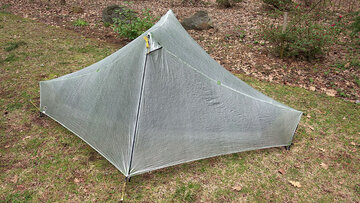
3. Six Moon Designs Lunar Solo — 740 g (26 oz)
The Six Moon Designs Lunar Solo is made of silicone-coated polyester: a 20D canopy over a 40D floor. At 740 g without stakes or pole, it is within 5 g of the X-Mid 1.
What it offers is room and price. Its 26.25 sq ft floor is the largest here, 48 in at its widest, and it pitches on one pole set to 49 in. It costs $260, the lowest price here. The costs are a single wall, one door and unsealed seams; Six Moon charges $35 to seal them before shipping.
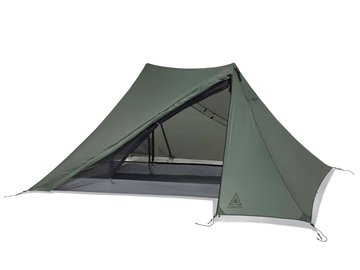
4. Durston X-Mid 1 — 745 g (26.2 oz)
The Durston X-Mid 1 is in its third generation, launched in March 2025, with sturdier zippers and a new floor fabric for 2026. The fly is 15D silpoly and the floor 15D nylon. The complete tent weighs 745 g; with sacks and six stakes Durston lists 835 g, still under 2 lb.
Two trekking poles sit offset on a diagonal ridgeline, which Durston says adds 15-25% interior volume over a perpendicular ridgeline and keeps the poles out of the doorways. The pitch is fly first on four stakes. Two doors open onto two 10.2 sq ft vestibules, the floor is 93 x 33 in, and the seams are factory waterproofed. It costs $269.
Packed Size Note
All four makers publish a packed size. The Plex Solo Classic rolls tight to about 4 x 11 in, the Lunar Solo to 11 x 4.5 in and the X-Mid 1 to 12 x 5 in. The Notch Li is the longest at 16 x 4 in; its struts come out of the fly.
Freestanding vs. Trekking-Pole
None of the four is freestanding. The Plex Solo Classic and Lunar Solo stand on one pole each; the Notch Li and X-Mid 1 use two. Only the Notch Li and X-Mid 1 come with stakes. Each maker sells a dedicated pole for hikers without trekking poles.
Closing
If weight alone governs the decision, the Plex Solo Classic has no peer in this group. If weight, space, weather protection and price are weighed together, the Durston X-Mid 1 is the more defensible choice. The Notch Li sits between them, for buyers who will pay $260 more to save 172 g in a double-wall tent. Durston’s X-Mid Pro 1, a hybrid single-wall tent with a DCF canopy, is another route: $599 and 485 g with a silnylon floor, or $689 and 440 g with a DCF floor. The Lunar Solo remains viable on price and floor space, but it weighs as much as the X-Mid 1 without a second door or a separate inner.