Best Ultralight Down Jackets for Alpine Starts
An alpine start demands insulation that packs small, layers without bulk, and holds enough warmth to survive the approach before output heat takes over. This comparison evaluates four hooded down jackets against those requirements: the Arc’teryx Cerium Hoody, the Patagonia Down Sweater Hoody, the Haglöfs L.I.M Down II Hood, and the Norrøna Trollveggen Down800 Super Light Hood. The October 2026 update replaces two discontinued jackets: the original L.I.M Down Hood and Norrøna’s Trollveggen Superlight Down850 Hood.
A note on methodology: specifications are drawn from the manufacturer product pages linked above. Patagonia’s figures are taken from its product copy as published by Patagonia-brand dealers. Where a value is not published, this page says so rather than estimate. Arc’teryx, Patagonia and Haglöfs publish weights without a size; Norrøna quotes size L.
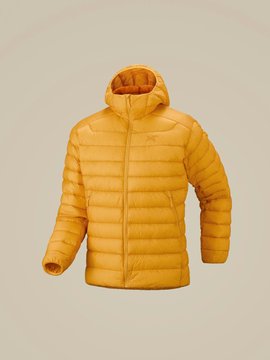
Arc’teryx Cerium Hoody
Switchback Travel calls the Cerium Arc’teryx’s flagship lightweight down jacket, and its 2026 down jacket guide names it the best performance down jacket. The product page lists 850-fill European white goose down with Coreloft 80 synthetic insulation mapped to areas where moisture builds up. Switchback Travel’s review (2026) places those panels at the shoulders, underarms, cuffs and the collar in front of the mouth. Down loses loft when wet; synthetic fill largely does not. With a pack on and sweat or rime in the air, that mapping covers a real gap.
The shell is the recycled 15D Arato 15, which replaced a 10D fabric when the Cerium LT became the Cerium in 2022 (The Big Outside, 2023; GearJunkie, 2024). Switchback calls it the more durable of the two. The fit is trim, and the StormHood is listed as helmet compatible. Switchback found it fits over a low-profile climbing helmet, though it can tug at the neck, and is too small to go over a ski helmet. The same review notes the interior can turn clammy with sweat during activity. Arc’teryx publishes 338 g (11.9 oz). At $400 it is the most expensive jacket here.
Buyers who want fewer grams can look at the Cerium SL Hoody, which Arc’teryx pitches for low-output alpine activities: 1000-fill down with Coreloft synthetic panels, a 10D Pertex Quantum shell, 234 g and $450, with no helmet compatibility listed.
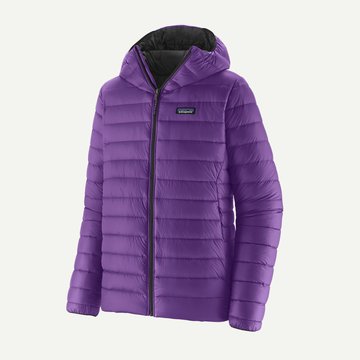
Patagonia Down Sweater Hoody
The Down Sweater Hoody (style 84702) uses 800-fill down certified to the Responsible Down Standard by Control Union, in a 20D NetPlus shell, a recycled nylon ripstop made from recycled fishing nets. It weighs 420 g (14.8 oz), has a regular fit and costs $345. The hood has a single-pull adjuster; Patagonia’s listing does not describe it as helmet compatible.
Switchback’s 2026 down jacket guide names the non-hooded Down Sweater ($289) its best overall down jacket and lists the Hoody as the hooded alternative. That matches its role here: a sound general-purpose layer, not a dedicated alpine one. It is the heaviest jacket in the group, the regular cut adds volume under a shell, and Patagonia lists neither synthetic mapping nor a down treatment for wet zones.
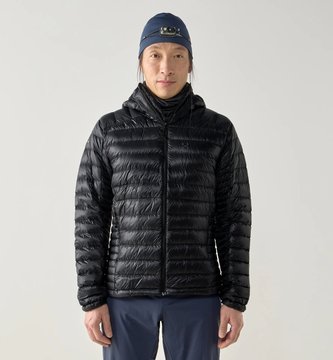
Haglöfs L.I.M Down II Hood
L.I.M stands for Less Is More, Haglöfs’ label for cutting weight, bulk and complexity. The L.I.M Down II Hood replaced the original L.I.M Down Hood, which now sits out of stock in Haglöfs’ outlet.
It is a hybrid: 800-fill goose down treated with ExpeDRY, which Haglöfs says actively evaporates moisture, plus Mimic SILVER polyester sheet insulation, with body-mapped down baffles. The shell is 10D Pertex Quantum at 26 g/m2 with a DWR made without intentionally added PFAS. Haglöfs publishes 300 g, a slim fit, and a snug hood that fits under a helmet rather than over it.
On paper it is the closest challenger to the Cerium: also hybrid, 38 g lighter, with a lower-denier 10D shell. The limits are intent and availability. Haglöfs lists it for trekking and hiking, prices it at EUR 329 and NOK 3,499, and has no working US storefront or USD price.
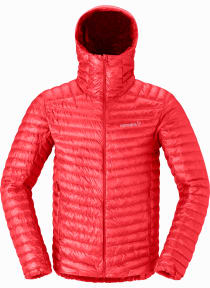
Norrøna Trollveggen Down800 Super Light Hood
Trollveggen is Norrøna’s heavy-duty mountaineering line, and Norrøna calls the Trollveggen Down800 Super Light Hood “our lightest and most packable hooded down jacket”. It takes the slot held in earlier versions of this page by the Superlight Down850 Hood, which Norrøna no longer lists. The newer jacket uses RDS-certified 800+ fill duck down treated with ExpeDRY in a recycled 10D nylon shell, a step down on paper from the Down850’s 850-fill goose.
Norrøna publishes 266 g in size L, the lowest weight here. The cut is technical, with a longer back, and Norrøna rates it as a mid-layer or outer layer for all four seasons. The page describes a high, protective collar and hood but says nothing about helmet compatibility. Norrøna lists it at $329 in the US, €299 in the EU, £280 in the UK and NOK 3,599 in Norway.
Category Trends
Three patterns show up in this lineup. Treated down is standard in the lighter hoodies. The Haglöfs and the Norrøna both use ExpeDRY (the original L.I.M Down Hood already used hydrophobic goose down), and Norrøna traded the Down850’s 850-fill goose for 800+ ExpeDRY duck. Switchback’s 2026 guide says hydrophobic down “has changed the game”, while noting it still trails synthetics in truly wet conditions. Hybrid construction is not unique to Arc’teryx: the L.I.M Down II, like the L.I.M Down Hood before it, pairs down with Mimic SILVER synthetic insulation. Where shells have changed, they have moved toward durability: the Cerium went from 10D to 15D when the Cerium LT became the Cerium in 2022, and Norrøna’s lightest hood went from a 7D shell on the Down850 to 10D.
Closing
For alpine starts the requirements are narrow: low weight, a hood that works with a helmet, a trim fit for layering, and enough warmth to cover the approach. All four manufacturers publish weight, fabric and fill, so the comparison rests on construction. The Cerium is built for that brief. The Trollveggen is developed for mountaineering but Norrøna does not state helmet compatibility, and the L.I.M Down II is listed for trekking and hiking, with a hood made to go under a helmet. The Patagonia is a general-purpose layer, and it shows in the weight and the cut.
The Cerium is the only jacket here that pairs synthetic insulation in the wet zones and a trim fit with a hood that goes over a low-profile climbing helmet, and it costs $400 and 38 g more than the Haglöfs for that. The Haglöfs suits European buyers who wear the hood under a helmet; the Norrøna suits buyers who put weight and US price ahead of synthetic mapping.