Ultralight Rain Jackets for Thru-Hiking: Three Compared
Comparison method: This is a comparison of published specifications and cited sources. Treeline Index has not tested these three jackets side by side. The recommendations reflect their listed features and intended use; they are not measured rankings of rain protection, breathability or durability.
Three waterproof shells sit at the light end of what thru-hikers carry. Each makes a different bet on weight, venting and fabric. This comparison covers the Zpacks Vertice Rain Jacket, the Patagonia Storm Racer Jacket and the Arc’teryx Norvan Jacket. All three pair a waterproof, breathable layer with a DWR finish made without PFAS. None is insulated. Only the Vertice is designed around a backpack; the Storm Racer and Norvan are trail-running shells. The differences are weight, venting, hood, pockets and price.
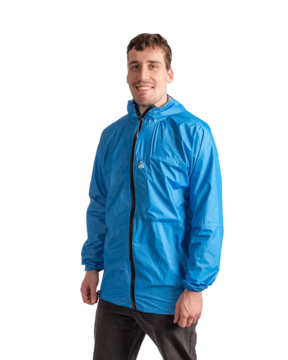
Zpacks Vertice Rain Jacket
The Vertice is the lightest and least expensive jacket here. Zpacks lists 160 g for a men’s medium, 152 g for a small, and $299 on the product page. The fabric is Zpacks’ own Vertice laminate at 51 g/m²: a 7-denier ripstop nylon face, a waterproof, vapour-permeable membrane and a tricot lining. On its materials page, Zpacks rates it above 20,000 mm of water resistance and above 56,000 g/m²/24 hr of vapour transfer (JIS L 1099 B1). Seams are fully taped.
It is the only jacket here with pit zips, and the only one whose hood is cut to fit over a climbing, ski or cycling helmet. The hood has a visor, a rear strap for vertical adjustment and elastic that cinches with one hand. Organisation is minimal: one chest pocket, placed to stay reachable with a pack on, which turns inside out to hold the jacket.
The trade-offs follow from the weight. The 7-denier face is the finest of the three, so pack straps and brush deserve some care over a long trail. Like the other two, the Vertice depends on its DWR. Zpacks advises machine washing it with Grangers Repel Plus or a similar product once beading fades.
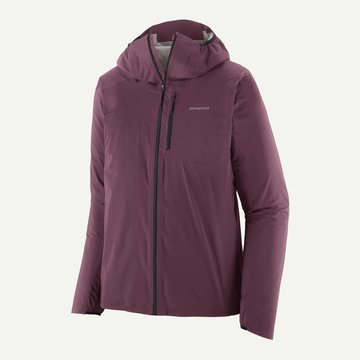
Patagonia Storm Racer Jacket
The Storm Racer is Patagonia’s waterproof running shell. It uses three-layer H2No Performance Standard fabric: a 20-denier recycled nylon ripstop face, a waterproof, breathable barrier and a 7-denier tricot backer, finished with a DWR made without PFAS. Patagonia’s product page lists 204 g for the men’s jacket; OutdoorGearLab (2025) measured 207 g in a men’s medium. US list price is $315.
The design is built for running. The cut is slim. The hood tightens with a single pull but is not made to go over a helmet. There is one zippered chest pocket, which doubles as the stuff sack, and no hand pockets. There are no pit zips or other vents.
For a thru-hiker, the lack of venting is the main cost. On a long climb in warm rain, the front zip is the only way to dump heat. Its 20-denier face is the highest denier of the three, which is the better bet against pack wear. Patagonia’s Worn Wear programme, which handles repairs and resale, is a useful backstop on a long trail.
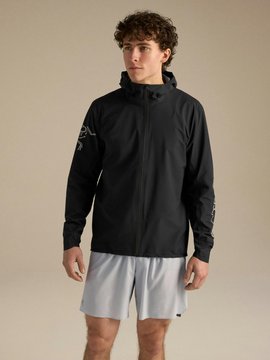
Arc’teryx Norvan Jacket
The Norvan Jacket is the current name for what Arc’teryx sold as the Norvan Shell. It is a three-layer GORE-TEX ePE shell with a 15-denier recycled nylon face and a GORE C-KNIT backer. Arc’teryx says both the ePE membrane and the FC0 DWR are made without PFAS. The product page lists 215 g and $450, which makes it the heaviest and most expensive jacket here.
Its case rests on ventilation. Arc’teryx places vents under the arms and at the back yoke, and says they keep air moving even under its Norvan running vest. Other details are running-specific: a fitted, articulated cut, a low-profile hood with a single-pull adjuster, laminated cuffs with a small watch window in each sleeve, reflective logos and a RECCO reflector. The only pocket is a zippered hip pocket, where a pack hipbelt can get in the way; the jacket stows into it.
Gore no longer offers its faceless GORE-TEX Shakedry fabric; Cyclingnews reported the discontinuation in 2022. Like the other two, the Norvan has a conventional face fabric and relies on its DWR. Arc’teryx patterns the fitted cut to sit over first layers, so a bulky insulated layer underneath may not fit.
How to Choose
Weight-first hikers on long trails — PCT, AT, CDT — will find the Vertice hardest to argue against. It is the lightest jacket here, the cheapest at $299, and the only one with pit zips and a helmet-compatible hood. The cost is the finest face fabric of the three.
The Norvan Jacket suits hikers who also run, or who want GORE-TEX with built-in underarm and yoke vents. It costs $151 more than the Vertice, and its listed 215 g is 55 g above a men’s medium Vertice.
The Storm Racer sits between them on price and weight. Its heavier face fabric favours durability. No vents and a hood that will not take a helmet make it the least suited to long, warm, wet climbs under a pack.
All three are sold as waterproof shells. That does not establish equal performance or guarantee a dry inner layer: perspiration, ventilation, fit and the condition of the garment also matter. Before choosing, compare your required fit and vents, then use our guides to waterproof and breathability ratings and rainwear ventilation to interpret the specifications. REI explains how membranes, DWR and perspiration affect comfort.