Best Ultralight Tarps for Thru-Hiking
Choosing a shelter for a long trail comes down to three constraints: carried weight, reliable protection, and the ability to pitch in imperfect conditions. Tarps occupy the lightest end of the shelter spectrum. All four options here are offered in Dyneema Composite Fabric (DCF), which removes the variable that most complicates silnylon comparisons: moisture absorption. Silnylon gains measurable weight when wet and needs re-tensioning as it stretches; DCF does neither. On a thru-hike measured in months, those differences compound.
The lineup runs from open to enclosed: flat tarps from Hyperlite Mountain Gear and Zpacks, Zpacks’ shaped Hexamid Pocket Tarp with storm doors, and Mountain Laurel Designs’ SoloMid Pro, a single-pole pyramid launched in March 2026. The comparison focuses on weight per square metre of coverage, pitch versatility, and the practical trade-offs of DCF.
Hyperlite Mountain Gear Flat Tarp
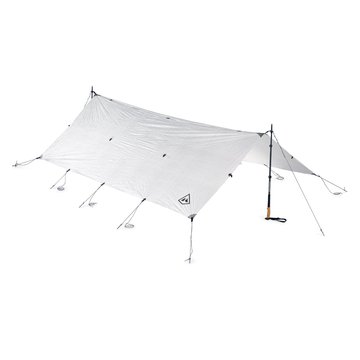
The HMG Flat Tarp is the more pitch-flexible of the two flat tarps here: a non-catenary panel of 0.75 oz/sqyd DCF with square corners, a bonded, stitchless ridgeline seam, 16 reinforced perimeter tie-outs and 6 body tie-outs. It comes in two sizes: 8’6” x 8’6” at 255 g (9.0 oz) and $390, and 8’ x 10’ at 309 g (10.9 oz) and $420. Twelve UHMWPE-core guylines and a stuff sack are included.
The panel pitches as a lean-to, A-frame, porch or low wind barrier depending on anchors. Without shaping or doors, storm protection depends on site selection and rigging.
DCF note: The heavier 0.75 oz/sqyd fabric costs grams against the Zpacks flat tarp but adds opacity and durability, which count over months of daily pitching.
Zpacks 8.5’ x 10’ Flat Tarp
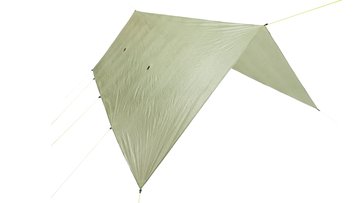
The Zpacks 8.5’ x 10’ Flat Tarp is the closest like-for-like alternative to the HMG. It is cut from .55 oz/sqyd DCF in Olive Drab, with a taped ridge seam and 16 tie-outs with bonded reinforcements. Zpacks lists it at 182 g (6.4 oz) and $399. A stuff sack, 50 ft of 1.6 mm cord and two carabiners ship with it, adding 41 g that the listed weight leaves out.
It covers 85 sq ft against 80 sq ft for HMG’s 8’ x 10’, at 127 g less and $21 less. The trade is fabric: Zpacks offers .75 DCF on other shelters for opacity and durability, but not on this tarp. A 7’ x 9’ version is $349 and 132 g.
Zpacks Hexamid Pocket Tarp
The Zpacks Hexamid Pocket Tarp is a shaped, floorless canopy that pitches on a single 52 in (132 cm) trekking pole with 6 to 10 stakes. Two overlapping storm doors open or close independently; with both closed, it gives 360-degree rain protection. Zpacks shares the design with its Plex Solo Classic tent, the successor to the discontinued Plexamid.
At 155 g (5.5 oz) in .55 DCF, it is the lightest tarp here and packs to 3 x 6 in (0.7 L). The Spruce Green version uses .75 DCF and weighs 186 g. Price is $399, or $529 with the optional DCF bathtub groundsheet. The canopy is 96 in long and 62 in wide at the centre, including an 18.5 in deep front vestibule. It is shorter than either flat tarp, and the fixed shape allows fewer pitch variations.
With the doors closed, condensation from breath and damp ground collects on the non-breathable DCF; opening a door helps. Zpacks puts the expected lifespan at one full 2,500+ mile thru-hike at least.
Mountain Laurel Designs SoloMid Pro
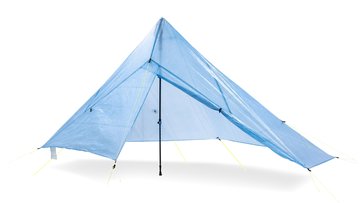
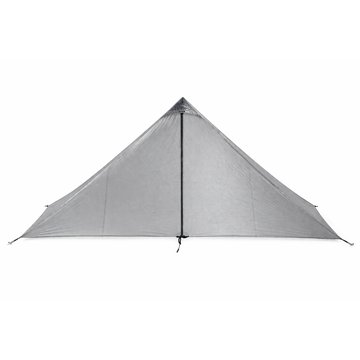
MLD no longer sells the Cuben SoloMid. Its successors are the SoloMid XL, which MLD lists as a tent (396 g in .75 DCF), and the SoloMid Pro, which MLD lists under both tarps and tents. MLD says the Pro is very close in size and function to the first SoloMid.
It is an asymmetric single-pole pyramid, 51 x 108 in with a 50 in peak when pitched 5 in off the ground. About 75% of the space sits behind the pole; the front 25% is a vestibule behind a zippered door. It pitches on six perimeter tie-outs and any adjustable pole of 125 cm or longer.
In .5 DCF it weighs 178 g (6.5 oz) without its six LineLocks, which add 14 g, and costs $455. The 20D silpoly version is 294 g (10.4 oz) and $285. The catch is availability: MLD tells buyers not to order .5 DCF products while the fabric is out of stock, and it sells in monthly ordering windows, with build times of 3 to 6 weeks for large items. MLD calls the Pro a specialist tool for experienced hikers on 3-season trips mostly below treeline, and points anyone over 6’1” to the SoloMid XL.
DCF vs. Silpoly: The Core Trade-Off
DCF is no longer a given for cottage tarps. Yama Mountain Gear has phased out DCF for its tarps: its 1P Cirriform Tarp is now silpoly only, at $185 and 332 g, while the discontinued DCF version last listed at $395. The SoloMid Pro shows the trade in one product: DCF saves 116 g and costs $170 more. MLD says the DCF version packs about 20% larger than the silpoly one, and that the Pro’s lighter silpoly is not quite as strong as the standard 20D silpoly in its larger shelters.
Silnylon costs less and is more abrasion-resistant, but it absorbs water and stretches when wet. Silpoly narrows that gap: Yama says it absorbs less water than silnylon and sags less. On a weekend trip the differences are minor. On a five-month thru-hike, the cumulative weight of a wet shelter packed each morning is a real factor.
For the flat tarps, weight per square metre follows from published dimensions: about 23 g/m² for the Zpacks 8.5’ x 10’ (7.9 m²), 38 g/m² for HMG’s 8’6” square (6.7 m²) and 42 g/m² for its 8’ x 10’ (7.4 m²). With its 41 g of extras, the Zpacks figure is about 28 g/m². HMG’s figures come from its spec table; its buy box shows a heavier 10.6 oz (300 g) for the 8’6” White, without saying what that includes. The shaped tarps have no published fabric area, so they do not compare directly.
All four tarps are credible choices for long-trail use. The decision narrows to geometry preference and pitch discipline: flat tarps reward skill, pyramids reward simplicity, and shaped tarps with doors split the difference.