Best Zero-Drop Trail Runners for Thru-Hiking
Zero-drop trail runners have become the default footwear for a large share of long-distance hikers. The flat platform keeps heel and forefoot level, and most of these shoes pair it with a wide toe box that leaves room for swelling feet. It is not for everyone: iRunFar’s TrailFly Zero V2 review notes that zero drop can be a hard sell for people not adapted to it. This page covers the Altra Lone Peak 9+, Topo Athletic Pursuit 3, INOV8 TrailFly Zero V2 and Altra Olympus 7. It previously listed the Lone Peak 8, Topo MTN Racer 3, Inov-8 TrailFly G 270 and Olympus 5, all since replaced. The MTN Racer, with its 5 mm drop, never belonged in a zero-drop list.
Weights are per shoe in a men’s US 9: Running Warehouse’s in-house figures for the three models it sells, and iRunFar’s measurement of a men’s 9 Wide for the TrailFly Zero V2. Manufacturer figures differ. Altra’s Australian store lists 327 g for the Lone Peak 9+ and 325 g for the Olympus 7 without stating a size, Topo lists 10.6 oz (about 300 g) for a men’s 9 Pursuit 3, and INOV8 lists 247 g. Prices are US list prices as of October 2026.
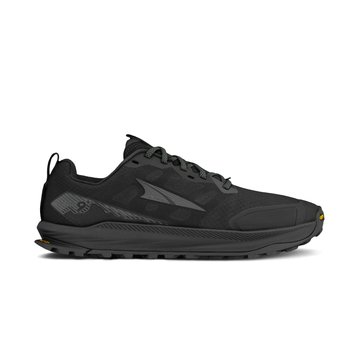
Altra Lone Peak 9+
The Lone Peak is still the reference point for zero-drop thru-hiking. Treeline Review’s 2026 trail shoe guide lists the 9+ as Best for Long Distance, and Switchback Travel (June 2026) calls the line wildly popular on thru-hiking trails. The 9+ is the version that matters. The Lone Peak 8 and the plain Lone Peak 9 ($145) use Altra’s own MaxTrac rubber; the 9+ adds a Vibram Megagrip outsole for $160. The 25 mm stack sits mid-group, with a StoneGuard layer underfoot and an RPET ripstop upper with no-sew overlays. Durability has been the line’s weak point. Switchback reports mixed longevity across versions 5 through 8, including a Lone Peak 8 upper blown through at the sides in under 200 miles, and says its 9+ pair is holding up better thanks to upper reinforcements and more durable outsole rubber. The Original FootShape fit, Altra’s roomiest toe box, suits feet that swell over consecutive high-mileage days, and a Wide version is sold. Specs at altrarunning.com.
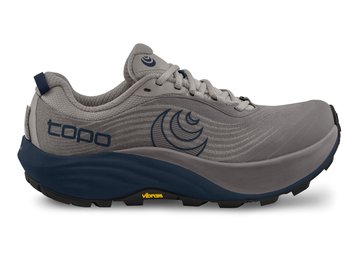
Topo Athletic Pursuit 3
Topo’s cushioned zero-drop trail shoe is the Pursuit. The MTN Racer that appeared here before has a 5 mm drop, as does the current MTN Racer 4. The Pursuit 3 runs a flat 28 mm stack by Topo’s figure, with a ZipFoam midsole and a Vibram Megagrip outsole whose widely spaced lugs Topo says release mud and snow. It is gaiter compatible, uses a quick-draining FKT insole and has no rock plate. At 306 g it weighs about the same as the Lone Peak 9+ while adding 3 mm of stack, and at $155 it is the least expensive shoe here. The reservations are about fit. Believe in the Run (July 2026) said the roomier upper left the reviewer never fully secure over the midsole, and found the ZipFoam firm for the amount of stack. Topo does not publish the upper material or lug depth, and its US store lists no wide sizes. Specs at topoathletic.com.
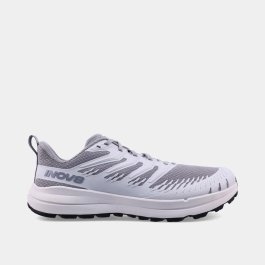
INOV8 TrailFly Zero V2
INOV8, which now styles its name without the hyphen, has moved this line from the TrailFly G 270 through the TrailFly Zero to the TrailFly Zero V2. It is the lightest and lowest shoe here: iRunFar weighed a men’s 9 Wide at 277 g and gives a 22 mm stack. The midsole is FLYSPEED PRO, a supercritical nitrogen-infused foam. The G-GRIP graphene rubber outsole has 4 mm lugs set out for hard and rocky ground, and INOV8 claims the reformulated compound has 50% more wet slip resistance than the first generation. Every TrailFly model comes in Standard and Wide fits, and INOV8 suggests Wide for more room on longer runs. Stronger KPU overlays replace the earlier 3D-printed ones. The catch is intent. INOV8 pitches the shoe at faster racing and training runs, and 22 mm is the least protection in the group under a loaded pack. At $175 it is the second most expensive shoe here. Details at inov8.com.
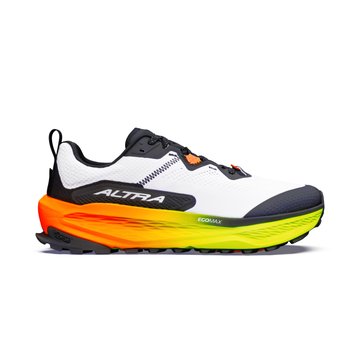
Altra Olympus 7
The Olympus 7 replaced the Olympus 6, which had replaced the Olympus 5 in 2024. It reached Altra’s US store at the end of July 2026 at $195, the highest price here. Its 33 mm stack is the tallest in the group, 5 mm above the Pursuit 3 on Topo’s figure and 2 mm above it on Running Warehouse’s. Altra says the updated EGO MAX foam is 15% lighter and 10% softer than before, and Running Warehouse puts the shoe roughly 1 oz lighter than the Olympus 6. The outsole is Vibram Megagrip with TractionLug, and molded TPU overlays reinforce the engineered mesh upper. The use case is specific: heavier packs, long days on rock, or hikers who want the most cushion available here. The costs are weight, at 320 g the heaviest in the group, and stability, since a 33 mm stack shifts more on off-camber sidehill than lower shoes do. It is more shoe than dry, hardpack trail requires. Specs at altrarunning.com.
Stack Height in Context
The range runs from about 22 mm (TrailFly Zero V2, per iRunFar) to 33 mm (Olympus 7). INOV8’s own figures, a 12 mm midsole plus a 6 mm footbed, total 18 mm before the outsole, so the number depends on what is counted. Running Warehouse’s measurements match Altra’s but put the Pursuit 3 at 31 mm. For most thru-hiking terrain, mixed hardpack, rock and dirt, the 25 to 28 mm the manufacturers list for the Lone Peak 9+ and Pursuit 3 is a practical middle ground, though Running Warehouse’s 31 mm for the Pursuit 3 puts it nearer the upper end. Below about 20 mm, rock strike on loaded days becomes fatiguing, and the TrailFly sits close to that line. Above 30 mm, lateral stability on technical tread becomes a genuine concern. The Olympus 7’s 33 mm earns its place under heavy loads. It should not be the default.
Durability at High Miles
The Lone Peak 9+, Pursuit 3 and Olympus 7 use Vibram Megagrip, and the TrailFly uses graphene-infused rubber. On the Lone Peak, Switchback Travel (June 2026) reports both failure modes on earlier versions: lugs dulled after about 100 miles on mild terrain, and a Lone Peak 8 upper blown through at the sides in under 200 miles. It found the upgraded MaxTrac rubber on the 9 held up considerably better, and the 9+ moves to Megagrip. All four uppers change in this generation. The Lone Peak 9+ reinforces its ripstop upper, the Olympus 7 adds molded TPU overlays and the TrailFly Zero V2 moves to KPU overlays. Believe in the Run found the Pursuit 3’s new mesh more durable than earlier Topo uppers, though Topo publishes no construction details. Altra’s Olympus 275 HiLo ($200, July 2026) goes further with a one-piece woven MATRYX upper, but it has no long-trail record yet. The Lone Peak line still has the deepest high-mileage community record here, mixed as it is. No maker here publishes a replacement interval, and Switchback’s reports show wear well before 500 miles on some pairs, so inspect uppers and lugs regularly rather than planning around a fixed mileage.