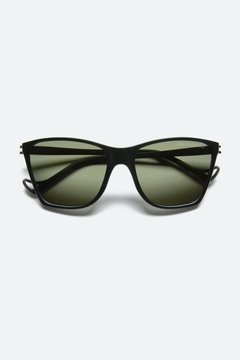
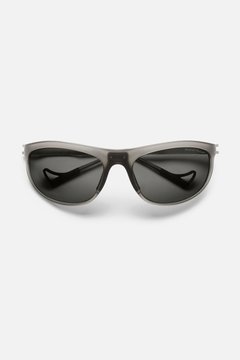
District Vision Keiichi vs Takeyoshi
District Vision designs running-first sunglasses, has every frame made in Japan and fits them with its own D+ polycarbonate lenses. This page first compared the Nako and the Keiichi. District Vision no longer sells the Nako Multisport, to give it its full name: a full-rim, two-lens frame with a rounded top and a 46 mm lens height, built for larger head shapes and still listed at $275 and 25 g in December 2025 (archived listing). The brand has not named a successor. The nearest current frame in role and price is the Takeyoshi Altitude Master: a two-lens, full-rim frame for outdoor sport, and the only current District Vision model besides the Keiichi that starts at $275. It takes the Nako’s place here.
An earlier version of this page also described the Keiichi as a single-lens wraparound shield with a “D+ Max Grey” lens. It is a two-lens full-rim frame, and District Vision lists no lens by that name.
Figures come from District Vision’s product pages and FAQ. Prices and stock are as of October 2026. Both frames use adjustable nose pads and temple tips with a grade 2 titanium core. District Vision does not publish the frame material for either.
District Vision Keiichi Standard
The Keiichi is where District Vision’s eyewear began. The brand launched in late 2015 with this single frame (Gear Patrol, 2016), and says it was developed over a two-year technical testing period with New York City athletes and Japanese engineering (districtvision.com).
It is the narrower frame of the two: 131 mm across the front, with 140 mm temples. The squared front reads as everyday sunglasses as much as sport eyewear. District Vision publishes no base curve for it and makes no helmet claim.
Seven lenses are offered across eight colourways, at $275 to $295, all in stock. Visible light transmission runs from 10.03% (D+ Earth Vision) to 23.56% (D+ Blue Ice), and every lens blocks 100% of UVA/B. D+ Earth Vision, D+ Water Gray and D+ Anti-Fog are polarized.
The Keiichi is also the only current District Vision frame offered with D+ Anti-Fog. The brand’s FAQ describes its anti-fog lens as porous, absorbing fog and light rain droplets. That matters on humid, slow efforts, where a lens steams up first.
District Vision Takeyoshi Altitude Master
District Vision describes the Takeyoshi as an 8-base frame “designed for rigorous outdoor pursuits”, engineered to aid ventilation and enhance the field of vision (districtvision.com). An 8-base curve is a pronounced wrap, which brings the lenses further around the sides of the face than a flatter frame.
At 136 mm across the front it is 5 mm wider than the Keiichi, which favours wider faces. The 125 mm temples are shaped for helmet use.
The lens range is broader: 16 D+ lenses across 24 colourways, from $275 to $350, with 22 of the 24 listings in stock. Fixed lenses run from 8.73% visible light transmission (D+ Amber Mirror) to 23.56% (D+ Blue Ice and D+ Gray Gradient), and D+ Earth Vision and D+ Water Gray are polarized. D+ Photochromic is rated CAT0-3; District Vision says it reaches about 15% transmission within 60 seconds in direct sun and will not darken behind most car windscreens. One colourway, Hazel with D+ Fire Mirror, has CNC-cut vents along the top edge of the lenses to let warm, humid air escape. There is no anti-fog lens.
For trail running, mountain days and anything under a helmet, the Takeyoshi is the better-equipped frame.
Head-to-Head
| Feature | Keiichi Standard | Takeyoshi Altitude Master |
|---|---|---|
| Frame | Full-rim, two lenses | Full-rim, two lenses |
| Base curve | Not published | 8 base |
| Frame width | 131 mm | 136 mm |
| Temple length | 140 mm | 125 mm, helmet-shaped |
| Total weight | 24 g | 24 g |
| Lens options | 7 | 16 |
| Polarized lenses | Earth Vision, Water Gray, Anti-Fog | Earth Vision, Water Gray |
| Fog control | D+ Anti-Fog lens | Vented lens, one colourway |
| Photochromic | No | Yes, CAT0-3 |
| US price | $275-$295 | $275-$350 |
Closing
Weight and starting price do not separate these frames: both are 24 g and both start at $275. District Vision’s FAQ says both can take prescription lenses from a local optician. The choice comes down to fit and use. The Takeyoshi’s 8-base wrap, helmet-shaped temples and wider lens range, photochromic included, make it the stronger pick for trail and mountain running. The Keiichi is narrower, carries the brand’s only anti-fog lens and passes for everyday eyewear, which suits road runners, narrower faces and city wear.