Enlightened Equipment Revelation 20°F vs Zpacks Zip Around Sleeping Bag 20°F
The Enlightened Equipment Revelation and the Zpacks Zip Around Sleeping Bag approach the same 20°F use case from opposite directions: a top quilt whose footbox opens flat, and a full-zip bag that also opens flat. This comparison uses each in its regular size, EE’s Regular/Regular and Zpacks’ Standard-Medium, both sized for sleepers up to 6 ft, and covers down, weight, rating basis and price.
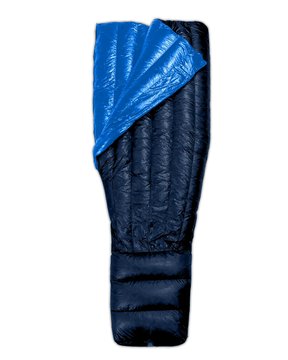
Enlightened Equipment Revelation 20°F
The Revelation is EE’s original and best-selling quilt. Details come from the manufacturer’s page at enlightenedequipment.com/revelation-sleeping-quilt and its configurator. The Trek’s 2026 quilt guide (January 2026) calls it the AT thru-hikers’ top choice and reports that nearly one in five Appalachian Trail thru-hikers in its 2025 survey used one.
Fill and insulation. Buyers choose between 850 fill power grey duck down and 950 fill power grey goose down, both RDS certified. EE’s size chart lists 456 g (16.08 oz) of fill for a 20°F Regular/Regular at 850 fill and 409 g (14.41 oz) at 950, for a 2.5 in target loft. EE lists the rating as 20°F (-6°C).
Weight and price. In the stock 10D fabric without a draft collar, the 20°F Regular/Regular lists at $375 and 633 g (22.32 oz) with 850 fill, or $490 and 585 g (20.65 oz) with 950 fill. The draft-collar option, a collar at the neck and another at the footbox cinch, adds $20 and about 28 g: $395 and 661 g with 850 fill, $510 and 614 g with 950. The stock 7D/7D shell saves about 25 g at the same price. Across all stock ratings, sizes and options the Revelation runs $280 to $655.
Shell and construction. Stock quilts use 10D nylon inside and out in three colorways, or 7D in one; the custom version offers 7D, 10D or 20D. All fabrics are PFC-free with a C0 DWR. U-shaped continuous baffles hold the down in place, and an included strap-and-clip system keeps the quilt on the sleeping pad.
Footbox and neck. The footbox closes with a 20 in zipper and shock cord and opens fully, so the quilt lies flat as a blanket. A snap and drawcord close the neck. There is no hood and no full-length zipper.
Lead time. Stock quilts are stuffed to order in Winona, Minnesota, from imported shells and ship in about 7 business days. Custom builds are made in the USA and ship in about 4 weeks.
Zpacks Zip Around Sleeping Bag 20°F
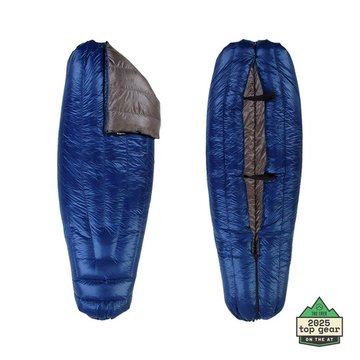
The Zip Around is a hoodless down bag whose full-length two-way side zipper continues around the footbox. Specifications come from zpacks.com/products/zip-around-sleeping-bag.
Fill and insulation. The fill is RDS-certified 950 fill power Muscovy duck down, ultrasonic-washed and free of added treatments. The 20°F (-7°C) Standard-Medium carries 412 g (14.5 oz) of it for a 2.5 in target loft, and Zpacks says each compartment is overstuffed with 30% more down than full loft requires. Vertical baffles in the upper body keep the down from shifting to the sides, and there are no sewn-through seams.
Weight and price. The 20°F Standard-Medium is $549 and 612 g (21.6 oz). The included roll-top dry bag adds about 25.5 g. Across ratings and sizes the bag runs $499 to $619 and 446 g to 818 g.
Shell. Shell and liner are 0.51 oz/sqyd Ventum ripstop nylon with a PFAS-free C0 DWR.
Zipper and coverage. Zipped, the bag closes around the sleeper with a rectangular footbox. Unzipped, it lies flat as a blanket, and opening only the bottom vents the feet. A draft tube and zipper guard run along the zip, and an elastic cord cinches the neck; there is no draft collar. Two Zip Arounds bought in November 2024 or later zip together.
Hood. None. Zpacks suggests a warm hat, its Down Hood, or sizing up in length to pull the bag over the head.
Lead time. The bag is made in the USA, and Zpacks lists it as shipping in 5 to 7 days.
Direct Comparison
Fill power: The Zip Around uses 950 fill down as standard. The Revelation matches it only with the 950 goose option, which adds $115. At 850 fill, the Revelation carries about 44 g more down for the same 2.5 in target loft.
Weight: The 850-fill Revelation is 21 g heavier than the Zip Around, or 49 g with the draft collar. The 950-fill Revelation is 27 g lighter without the collar and level with it.
Coverage: The Revelation is a top quilt, open underneath and held to the pad with straps. The Zip Around wraps the sleeper when zipped. Both open flat as a blanket on warm nights; only the Zip Around also closes into a bag. Zpacks’ own top quilt, the Solo Quilt, is $489 and 520 g in the same 20°F Standard-Medium size.
Temperature rating: Neither product page lists an ISO 23537 lab result, and both target the same 2.5 in loft at 20°F. EE’s support article on ratings says its ratings correspond most closely to the EN/ISO limit temperature, with comfort typically 10 to 15°F warmer, and that Kansas State University’s Institute for Environmental Research tested the 20°F Revelation on a heated manikin in 2016. Zpacks says its bags have not been ISO tested and estimates that its ratings sit closest to the ISO transition range, between the comfort and lower-limit figures, designed to keep an average person reasonably comfortable down to the listed temperature. For cold sleepers both brands advise a warmer bag than the forecast suggests: EE a rating at least 10°F below expected conditions, Zpacks the next warmer rating. EE’s product page extends that advice to most people.
Price: $375 for the 850-fill Revelation, $490 for the 950-fill version, and $549 for the Zip Around. Matched on 950 fill, the Revelation costs $59 less without the collar and $39 less with it.
Availability and lead time: Lead times are similar: 5 to 7 days for the Zip Around, about 7 business days for an in-stock Revelation. Stock Revelations are held by configuration, and some sell out: in October 2026 the 20°F Regular/Regular could be ordered only with the draft collar, while the 20°F Standard-Medium Zip Around was available in all four colorways.
Closing
Both are sold as 20°F pieces with the same 2.5 in target loft, but EE puts its rating at or near the ISO limit temperature, while Zpacks estimates its ratings sit in the transition range above the limit. At 20°F the Revelation is the cheaper choice at every fill. A cold sleeper following either brand’s advice for 20°F nights moves to a 10°F piece: in the regular size, the Revelation with 850 fill, 10D fabric and the collar is $420 and 757 g, the Zip Around $579 and 738 g. The Zip Around is the pick for a sleeper who wants a full bag on cold nights that still opens flat as a quilt, at close to a top quilt’s weight.