
Fjällräven vs Haglöfs Trekking Packs: Abisko Hike 35 vs L.I.M 35
Two Scandinavian brands. One category: the 35-litre trekking pack for hut-to-hut routes and short multi-day trips. Fjällräven and Haglöfs both have long histories in technical outdoor gear, and both work in a Nordic design tradition that puts function first. The question is which 35 L pack earns its place on a weight-aware hiker’s back.
Specs below are each brand’s published figures. Prices are UK list prices as of October 2026.
Fjällräven Abisko Hike 35
Fjällräven describes the Abisko Hike 35 as a pack for cabin-to-cabin hikes and lightweight trekking. It is sold as two products, S/M and M/L, each with an adjustable back length: 43-49 cm and 47-53 cm. The carry system pairs an aluminium frame with a padded back panel, and ventilating air mesh runs across the back panel, shoulder straps and hip belt. The hip belt is fixed and carries two pockets.
All fabrics are recycled polyamide, a 210D ripstop and a 500D fabric with a 210D lining, produced without PFAS. The main compartment loads from the top and also opens through a front zip. The detachable lid has two zippered pockets. There are two oversized side pockets, a front attachment for a trekking pole or ice axe, and hydration compatibility. A rain cover is included.
The cost is weight. Fjällräven lists the pack at 1,560 g. Some retailers still show an earlier 1,400 g figure. Either way it is the heavier pack here, by 640 g on the manufacturers’ numbers. Fjällräven’s UK store lists both sizes at £205. Details are on the Fjällräven Abisko Hike 35 M/L product page.
Best suited to: Hut-to-hut and multi-day trekking where an adjustable fit and a framed back matter more than pack weight.
Haglöfs L.I.M 35
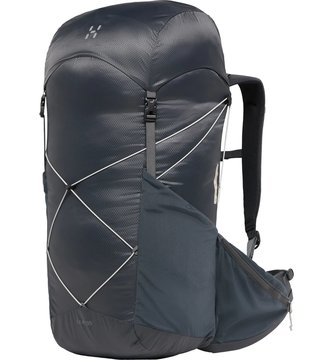
L.I.M, for Less Is More, is Haglöfs’ lightweight range, and the L.I.M 35 is its 35-litre hiking pack. It is a different pack from the L.I.M Strive 35, an earlier 35-litre L.I.M model from 2017 that is no longer in Haglöfs’ range. Haglöfs lists the L.I.M 35 at 920 g, in one size, measuring 59 x 31 x 25 cm.
The main fabric is a 70D polyamide diamond ripstop with a PU coating, rated above a 1,500 mm water column. The lining has a DWR finish without intentionally added PFAS. The carry is built around Haglöfs’ Airback suspension, a back panel designed for airflow, with a padded hip belt, load lifters and an adjustable sternum strap. Haglöfs publishes no frame details.
Storage is simpler than on the Fjällräven: a fixed top lid with a pocket, elastic side pockets, zippered hip belt pockets, an elastic compression cord and hydration compatibility. No rain cover or front opening is listed. Haglöfs’ UK store lists it at £160, and it is in stock as of October 2026. Details are on the Haglöfs L.I.M 35 product page.
Best suited to: Fast hikes and lighter multi-day loads where weight and price come first, for hikers the single size fits.
Direct Comparison
| Fjällräven Abisko Hike 35 | Haglöfs L.I.M 35 | |
|---|---|---|
| Volume | 35 L | 35 L |
| Weight (manufacturer) | 1,560 g | 920 g |
| Back length | Adjustable, S/M 43-49 cm, M/L 47-53 cm | One size |
| Carry system | Aluminium frame, padded back panel | Airback back panel, load lifters |
| Hip belt | Fixed, air mesh, 2 pockets | Padded, zippered pockets |
| Main fabric | Recycled polyamide, 210D ripstop and 500D | 70D polyamide diamond ripstop, PU-coated |
| Access | Top and front zip | Top, fixed lid |
| Rain cover | Included | Not listed |
| Price (UK) | £205 RRP | £160 |
The trade is clear on paper. The L.I.M 35 saves 640 g and £45. The Abisko Hike 35 answers with two adjustable sizes, an aluminium frame, heavier fabrics, front-zip access and an included rain cover. Neither brand publishes a load rating.
Closing Notes
For a weight-aware hiker, the L.I.M 35 is the stronger pick. At 920 g it is the lighter pack by a wide margin, and it costs less. Its padded hip belt and load lifters cover the basics of load transfer.
The Abisko Hike 35 makes more sense when fit is the constraint. Its two sizes span 43-53 cm of back length, while the L.I.M 35 comes in one size. The frame, heavier 210D and 500D fabrics and included rain cover suit hikers who value those more than a 640 g saving.