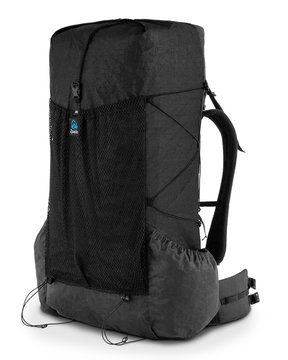
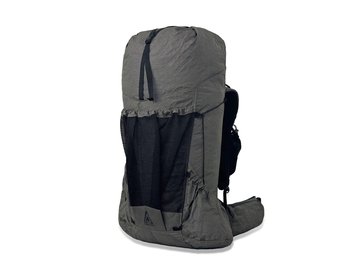
Zpacks Arc Haul Ultra 60L vs Durston Kakwa 55
Two packs come up in ultralight circles whenever the question is a 60-70 L hauler that doesn’t punish the scale. The Zpacks Arc Haul Ultra 60L, which replaced Zpacks’ original Arc Haul, is built around a curved carbon frame. The Durston Kakwa 55, from Dan Durston, the designer behind the X-Mid tent line, uses an aluminum U-frame. Both are framed packs, and both are current as of October 2026. The trade-off is clear once the specs are side by side: the Arc Haul is lighter and better sealed, while the Kakwa carries more, takes more weight and costs less.
Zpacks Arc Haul Ultra 60L
The Arc Haul Ultra 60L is detailed on the manufacturer’s page at zpacks.com/products/arc-haul-ultra-60l-backpack. Zpacks lists it at 619 g (21.8 oz) and $399, or $449 with Vest Straps. Its defining feature is the curved carbon fiber Arc Frame, which bows away from the back to leave an air gap. Torso height adjusts on three frame heights (17, 20 and 23 in) that together cover 16-26 in torsos, and the removable hip belt comes in four sizes from 25 to 55 in. Zpacks also sells a Women’s Arc Haul Ultra 60L, listed at 597 g.
The shell is 3.3 oz/sqyd Ultra 100X, a woven UHMWPE face fabric laminated to a waterproof backing. It is not Dyneema Composite Fabric. Zpacks describes it as PFAS-free and not coated with DWR. Seams and attachment points are taped, and Zpacks calls the finished pack highly water resistant.
Volume is 60 L total: a 47 L main body, two 2.5 L side pockets and an 8 L stretchy mesh center pocket, all standard. Hip belt pouches are sold as add-ons. Strap pockets come either as add-on pouches or with the $449 Vest Straps option, whose straps each carry a bottle pocket, a stow pocket and a small zippered pocket. Zpacks rates the pack at 30-35 lb for comfortable carry and 40 lb maximum.
The trade-offs are real. Switchback Travel’s review (updated April 2026) notes that the current fabric is thinner than the Ultra 200 used on earlier versions and advises care around snags and punctures. The main body is also the smaller of the two.
In September 2026 Zpacks added the Arc Pro 60L as a sibling, not a successor: the same 60 L volume split and carbon Arc Frame at 628 g and $449, with Venom stretch-mesh center, side and bottom pockets and a sit-pad sleeve. The Arc Haul Ultra 60L remains on sale, listed as shipping in 5 to 7 days.
Durston Kakwa 55
Durston’s pack is documented at durstongear.com/products/kakwa-55. It launched in December 2022. The current 2026 version adds a redesigned hipbelt with a lumbar pad and improved durability, more internal capacity, and two hipbelt sizes: S/M (28-45 in adjustment, for 29-38 in hips) and M/L (32-49 in adjustment, for 33-42 in hips).
The frame is a hollow aluminum inverted-U (90 g) with a 15 g backpad, and the pack has load lifters. Both frame and backpad are removable for frameless carry on light loads. Durston rates it to 45 lb.
The name understates the capacity. Internal volume is 53, 55 or 57 L across torso sizes S, M and L (15-22 in overall), plus 15 L of external pockets, for 70 L total in Medium. There is no women’s version.
Buyers choose between two fabrics. Ultra 200X is a woven UHMWPE fabric laminated to a film backing: $279 and 895 g (31.5 oz) in Medium. UltraGrid is a 210D nylon with a UHMWPE ripstop grid and a PU coating: $199 and 870 g. Either way the seams are not taped, and Durston calls the pack water resistant rather than waterproof.
Organization is where the Kakwa pulls ahead. Hipbelt pockets, shoulder strap pockets and a zippered QuickPocket in the left side pocket are all standard, and the front pocket uses a tougher low-stretch knit mesh instead of stretch mesh. The hip belt is fixed, though, so it cannot be swapped the way the Zpacks belt can.
OutdoorGearLab’s ultralight pack roundup (June 2026) ranked the Kakwa 55 second with its Best Buy award, one place above the Arc Haul Ultra (it tested the 50 L version); both scored 85. Availability has been the catch. Every variant was sold out in early October 2026; by mid-October Durston’s US restock was open for orders, while other regions are due to restock in late October. Check availability before planning around it.
Head-to-Head Summary
| Factor | Arc Haul Ultra 60L | Kakwa 55 |
|---|---|---|
| Weight (manufacturer) | 619 g | 895 g (M, Ultra 200X) |
| Volume | 60 L total (47 L main) | 70 L total (55 L internal, M) |
| Frame | Curved carbon Arc Frame | Removable aluminum U-frame |
| Max load | 40 lb | 45 lb |
| Shell | Ultra 100X | Ultra 200X or UltraGrid |
| Seams | Taped | Not taped |
| Hip belt | Removable, 4 sizes | Fixed, 2 sizes |
| Strap and belt pockets | Add-ons (Vest Straps add strap pockets) | Standard |
| Price (USD) | $399 to $449 | $199 to $279 |
Closing
Neither pack is wrong, and neither uses DCF. The Arc Haul Ultra 60L is lighter by about 276 g, with taped seams, an air gap behind the back, and the wider fit range of an adjustable torso and swappable belts. The Kakwa 55 carries 10 L more, is rated 5 lb higher, includes the strap and belt pockets that cost extra on the Zpacks, and costs $120 to $200 less. For a hiker counting grams on loads inside the Arc Haul’s 30-35 lb comfort range, the Arc Haul is the pick. For heavier food carries or a tighter budget, the Kakwa makes more sense.